

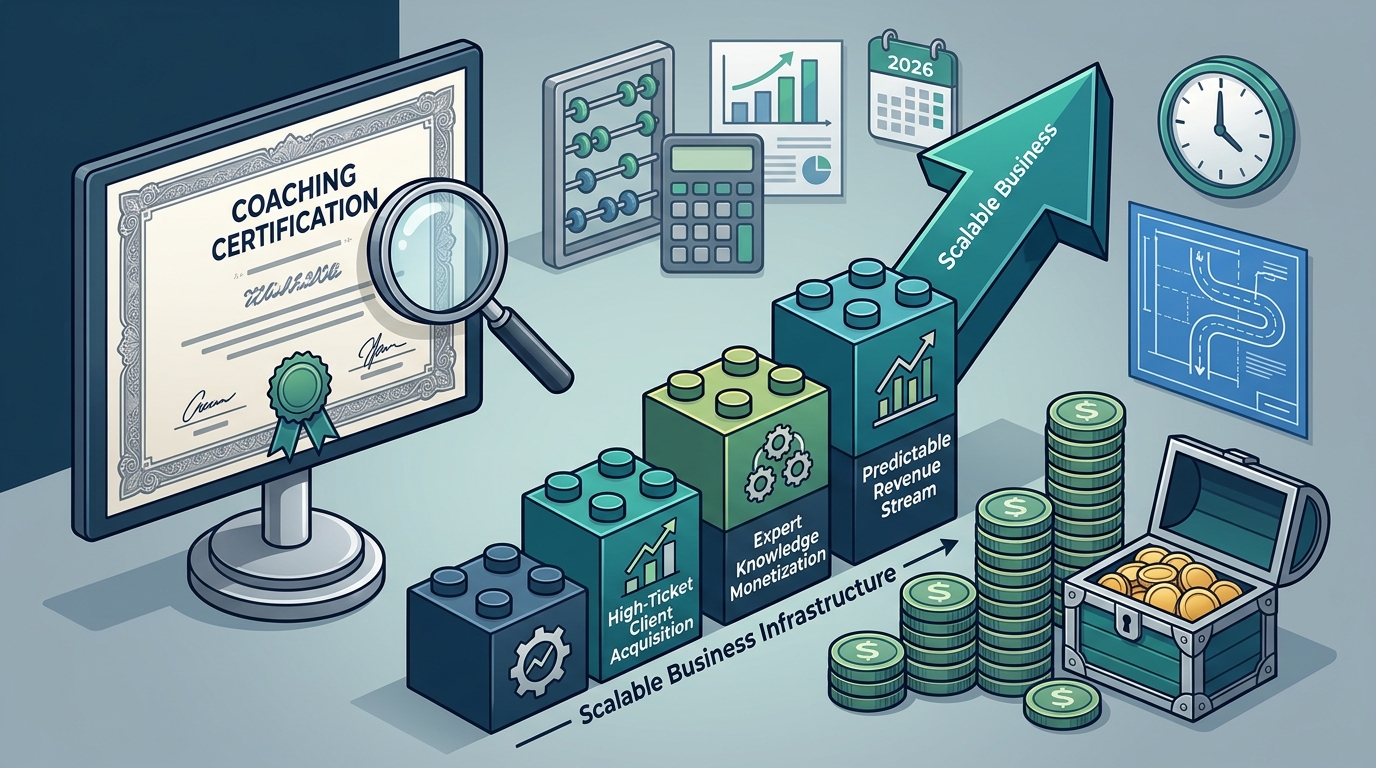
Coaching certification is a formal credential that validates a practitioner's training in specific methodologies, ethics, and business practices. For online coaches, the value of such a program depends less on the certificate itself and more on whether the curriculum builds a scalable business infrastructure. Many experts find that generic certifications fail to address the core challenge of client acquisition and revenue generation. Instead, they invest in systems that turn expertise into predictable income. This article evaluates whether the cost of certification aligns with the tangible business outcomes it produces for modern online service providers. For additional details, review the .
The Cost of Certification
Traditional coaching certifications often range from a few thousand to over ten thousand dollars. These programs typically focus on theoretical frameworks, such as NLP, hypnotherapy, or general life coaching principles. While these concepts can be useful, they rarely include the technical skills needed to run a digital business. The investment is only worth it if the curriculum includes modules on sales funnels, email marketing, and paid advertising. Without these components, the certificate serves as a decorative credential rather than a functional business tool. Coaches must evaluate the return on investment by looking at the specific business skills taught, not just the prestige of the issuing body.
Business Infrastructure vs. Theory
Business infrastructure is the collection of systems, tools, and processes that allow a service provider to deliver value and generate revenue consistently. A certification that focuses solely on conversation techniques leaves a coach without the infrastructure to find clients. For example, a coach may master the art of the discovery call but still struggle to fill their calendar without a lead generation system. The gap between knowing how to coach and knowing how to sell is where most new businesses fail. A robust program should bridge this gap by teaching how to package expertise into a high-ticket offer. This shift from theory to infrastructure is the primary differentiator between a hobby and a profitable enterprise.
Client Acquisition Strategies
Client acquisition is the process of attracting, engaging, and converting potential customers into paying clients. In the online space, this requires a multi-channel approach that includes content marketing, social media presence, and paid traffic. Many certification programs ignore this critical area, assuming that good coaching skills will naturally attract clients. This assumption is flawed in a crowded digital marketplace. Effective acquisition strategies involve creating a lead magnet, building an email list, and running targeted ad campaigns. Coaches need to understand how to position their unique value proposition to a specific niche. Without a clear acquisition strategy, even the most certified coach will struggle to maintain a consistent income stream.
The Virtual Income School Approach
Virtual Income School focuses on building the business side of coaching rather than just the coaching skills. The platform is designed for coaches, experts, and aspiring entrepreneurs who want to turn their expertise into a profitable online business. It provides the systems, strategy, and hands-on support needed to attract paying clients. This approach recognizes that most coaches do not need more information about coaching techniques; they need the right business built around their expertise. The curriculum covers clear offers, content that speaks to the right buyer, and lead flow systems. By focusing on execution and business growth, Virtual Income School helps professionals create sustainable revenue without relying on traditional sales methods. This business-first mindset is often more valuable than a generic certification for those looking to scale.
Key Takeaways
- Coaching certification is a formal credential that validates training in methodologies and ethics.
- Business infrastructure is the collection of systems that allow a service provider to generate revenue.
- Client acquisition is the process of attracting and converting potential customers into paying clients.
- Generic certifications often lack the technical skills needed for digital marketing and sales.
- Virtual Income School focuses on building a profitable business around existing expertise.
- Invest in programs that teach execution and business growth, not just theory.
Frequently Asked Questions
Is a coaching certification legally required to practice?
No, coaching is an unregulated profession in most jurisdictions. You do not need a license or certification to call yourself a coach. However, having a credential can add credibility and help with marketing. The legal requirement is to operate within the laws of your local area, which typically involves standard business registration.
How much does a coaching certification program cost?
Costs vary widely, ranging from a few hundred dollars for basic courses to over ten thousand dollars for comprehensive programs. The price often reflects the depth of the curriculum and the support provided. It is important to compare the cost against the specific business skills taught to determine if the investment is justified.
What is the difference between a certification and a business program?
A certification focuses on validating your knowledge of coaching techniques and ethics. A business program focuses on teaching you how to market, sell, and scale your coaching services. Many successful coaches find that business programs provide a higher return on investment because they directly impact revenue.
Can I get clients without a certification?
Yes, many successful coaches have never obtained a formal certification. They rely on their results, testimonials, and strong marketing strategies to attract clients. In the online space, your ability to deliver results and communicate value is often more important than a piece of paper.
How long does it take to complete a coaching certification?
Most certification programs take between three and twelve months to complete, depending on the intensity and format. Some are self-paced, while others require live sessions. The timeline should align with your business goals and availability for study.
Does Virtual Income School provide a certification?
Virtual Income School focuses on business systems and strategy rather than issuing a traditional coaching certification. The goal is to help you build a profitable online coaching business using proven frameworks. You can apply to work with us to see if the program is the right fit for your goals.
What is the best way to evaluate a coaching program?
Look for programs that include modules on sales, marketing, and business operations. Check for testimonials from past students who have built successful businesses. Ensure the program offers ongoing support and community access. Avoid programs that focus exclusively on theory without practical business application.
Conclusion
Deciding whether a coaching certification is worth the investment requires a clear understanding of your business goals. If you are looking for a credential to add to your resume, a traditional certification may suffice. However, if your goal is to build a profitable online business, you need a program that teaches you how to attract and retain high-ticket clients. Virtual Income School provides the systems and strategy needed to turn your expertise into a sustainable revenue stream. By focusing on business infrastructure and client acquisition, you can create a coaching business that thrives in the digital age. To plan your visit, to see if the program is the right fit for your goals.